For emerging designers and independent labels, navigating the world of garment production can feel overwhelming. One of the most common—and often frustrating—acronyms you will encounter is MOQ (Minimum Order Quantity).
When you find a factory that produces incredible work, only to discover their MOQ is out of your budget, it can be discouraging. However, understanding how a clothing manufacturer MOQ is calculated is the first step toward building a sustainable relationship with a production partner.
Here is what small brands need to know about minimum order quantity apparel manufacturing in 2026, and why it isn’t just an arbitrary number.
What Does MOQ Actually Mean?
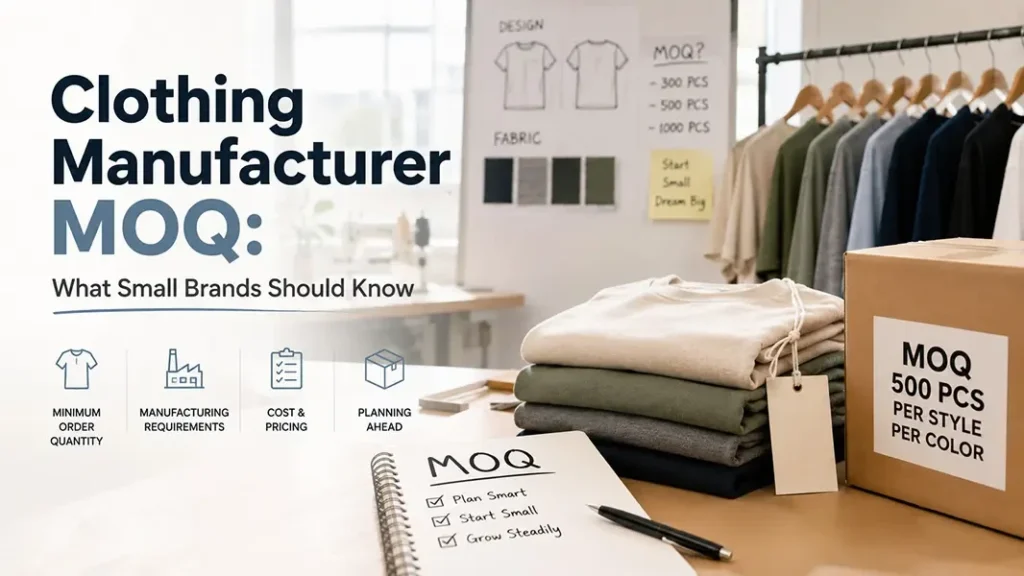
Simply put, an MOQ is the fewest number of units a factory is willing to produce for a single order. In the apparel industry, this is typically defined per style, per color. For example, an MOQ of 300 pieces means you must order at least 300 units of that specific hoodie in black, though those 300 units can be divided across different sizes (e.g., S, M, L, XL).
Why Do Factories Enforce MOQs?
Many new brands assume factories set high MOQs simply because they only want to work with massive corporations. In reality, MOQs are dictated by the hard costs and physical constraints of the manufacturing process:
1. Fabric Mill Minimums
Often, the clothing manufacturer MOQ is completely dependent on the fabric supplier. Standard, readily available “stock” fabrics might allow for smaller orders. But if you want a custom Pantone-dyed fleece, a specific weight (GSM), or a high-performance waterproof membrane, the fabric mill will require the factory to purchase a minimum amount of yardage—often enough to make hundreds of garments.
2. The Setup and “Tooling” Time
Manufacturing is not just pressing a button. Setting up a production line takes significant time and skilled labor. This includes:
- Developing the initial paper patterns and digital CAD grading.
- Calibrating sewing machines for specific stitch types.
- Creating custom molds for branded hardware (like zippers or toggles).
- Setting up screens for printing or digitizing files for embroidery. If a factory only produces 50 pieces, the cost of this initial setup is spread over a very small number of items, making the price per garment astronomically high for the brand.
3. Production Line Efficiency
Factories are optimized for flow. Once the line is running smoothly, operators become faster and more accurate. Stopping and starting the line constantly to switch between different, tiny orders disrupts this efficiency and increases the risk of errors. A reasonable MOQ ensures that the factory can deliver consistent quality.
How Small Brands Can Navigate MOQs
If you are struggling to meet high minimums, here are a few strategies to make your project more viable:
- Consolidate Your Colors: Instead of ordering 100 pieces in four different colors, order 400 pieces in your strongest, core color.
- Use Stock Fabrics: Be flexible on your materials. Ask your manufacturer if they have high-quality “available stock” fabrics that fit your design, which can bypass the high minimums of custom dyeing.
- Simplify the Tech Pack: Complex garments with multiple components (like technical outerwear) naturally require higher MOQs to ensure quality. Starting with a simpler silhouette can sometimes lower the barrier to entry.
The Five Oceans Approach to MOQ
At Five Oceans, we operate strictly as a made-to-order B2B facility with no standing inventory. We understand the challenges emerging brands face, which is why we don’t apply a blanket MOQ to every project.
Instead, we conduct a transparent feasibility analysis based on your specific Tech Pack. We evaluate your product architecture, material sourcing requirements, and decorative processes to propose a minimum order quantity apparel solution that balances your budget with our strict quality control standards.
Are you ready to discuss the specific MOQ for your next design? Contact our technical team today with your Tech Pack, and let’s figure out the most efficient way to bring your collection to life.