For apparel brands, navigating the path from a design sketch to a finished garment requires a deep understanding of the manufacturing ecosystem. A streamlined process not only ensures product quality but also optimizes costs and reduces time-to-market. At Five Oceans, we pride ourselves on our integrated approach to garment production.
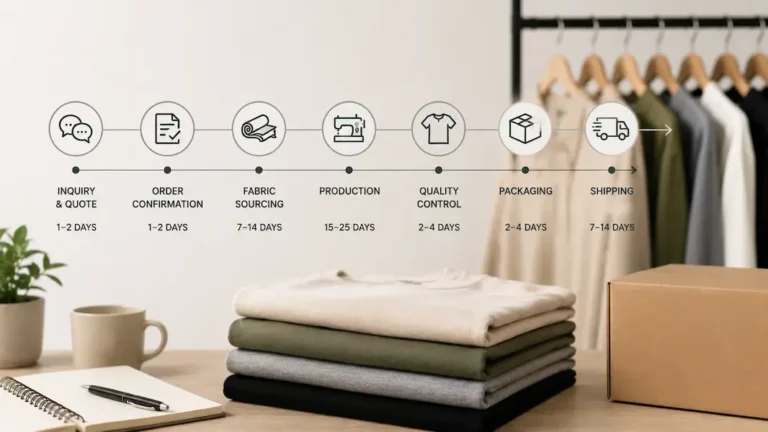
[Visual: S-Shaped Garment Manufacturing Workflow Diagram]

Stage 1: Design & Technical Development
Short answer: Stage 1 turns your idea into a complete tech pack — sketches, measurements, construction notes and trims. A precise pack is the single biggest factor in a smooth sample.
1. Tech Pack Creation
The foundation of every successful garment is a comprehensive Tech Pack. This document includes technical sketches, construction details, measurement charts, and a Bill of Materials (BOM). It serves as the primary communication tool between the brand and the factory.
Stage 2: The Sampling Cycle
Short answer: Stage 2 validates fit, fabric and construction on a physical sample. Standard knit samples take about two weeks; approve fit before bulk fabric is ordered.
Sampling is the most critical phase for risk mitigation. It allows for the physical validation of the design before bulk resources are committed.
| Sample Type | Primary Objective |
|---|---|
| Proto Sample | Validates the initial design concept and aesthetic. |
| Fit Sample | Tests measurements, proportions, and silhouette on a live model. |
| PP Sample (PPS) | The final “Golden Sample” using bulk fabrics and trims for production sign-off. |
Stage 3: Sourcing & Pre-Production
Short answer: Stage 3 locks in bulk fabric, trims and lab dips so color and hand-feel match the approved sample. No bulk cutting starts before this sign-off.
2. Material Sourcing & Lab Dips
Once the design is finalized, we source the bulk fabrics and trims. Lab Dips are created to ensure exact color matching against the brand’s standards (e.g., Pantone). All materials undergo rigorous testing for shrinkage, colorfastness, and durability.
Stage 4: Bulk Production
Short answer: Stage 4 covers cutting, sewing and assembly on dedicated lines, with in-process checks at each key step.
3. Cutting, Sewing & Assembly
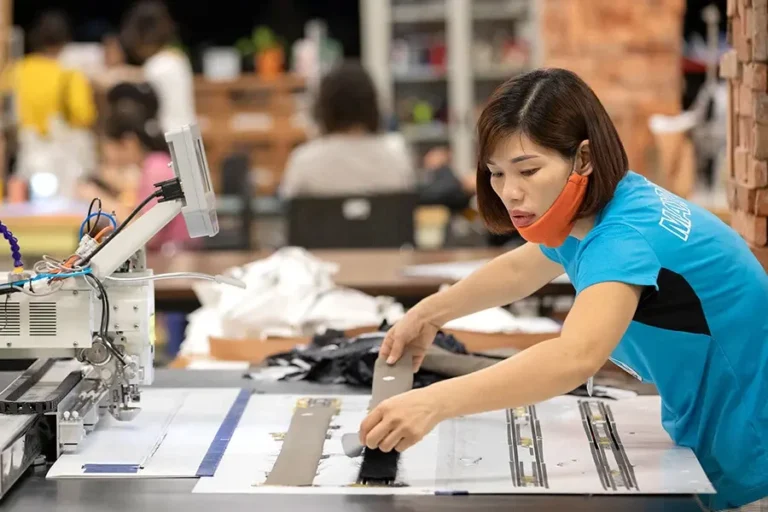
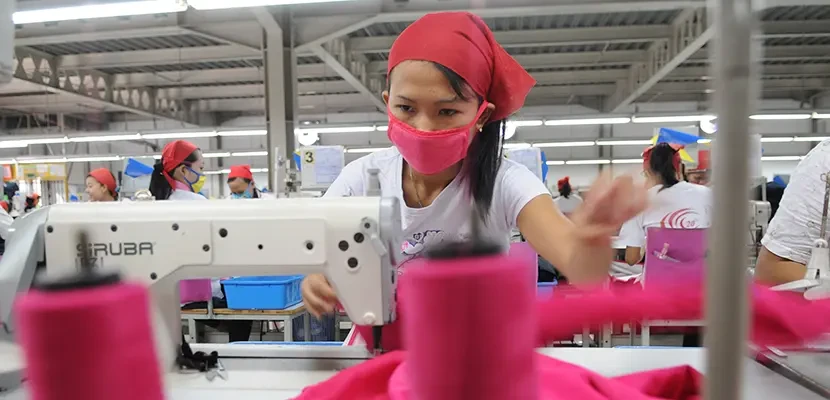
Using advanced CAD systems for pattern nesting, we maximize fabric utilization during cutting. The sewing phase is managed in specialized lines, where each operator focuses on specific components to ensure maximum efficiency and consistency.
Stage 5: Quality Control & Finishing
Short answer: Stage 5 includes incoming material checks, top-of-production review, in-line inspection and a final random inspection; the inspection standard is agreed per order.
Quality is not an act, but a habit at Five Oceans. We implement a multi-tier QC system:
- In-Line Inspection: Checking garments during the sewing process to catch errors early.
- Final Inspection: A comprehensive check of finished garments against the approved PPS using the inspection standard agreed per order.
- Finishing: Includes professional pressing, tagging, and final packaging according to brand specifications.
Stage 6: Logistics & Delivery
Short answer: Stage 6 handles packing, documentation and shipment by sea, air or land under the shipping term agreed in your contract.
The final stage involves coordinating the global shipment of your products. Whether by sea, air, or land, we ensure all documentation is accurate for smooth customs clearance and on-time delivery to your warehouse.
Technical References
- Textile Institute. Garment Manufacturing Technology: From Design to Quality Control.
- World Apparel Federation. Standard Operating Procedures for Global Garment Production. Available at: iafnet.com
- American Apparel & Footwear Association (AAFA). Best Practices in Apparel Supply Chain Management. Available at: aafaglobal.org