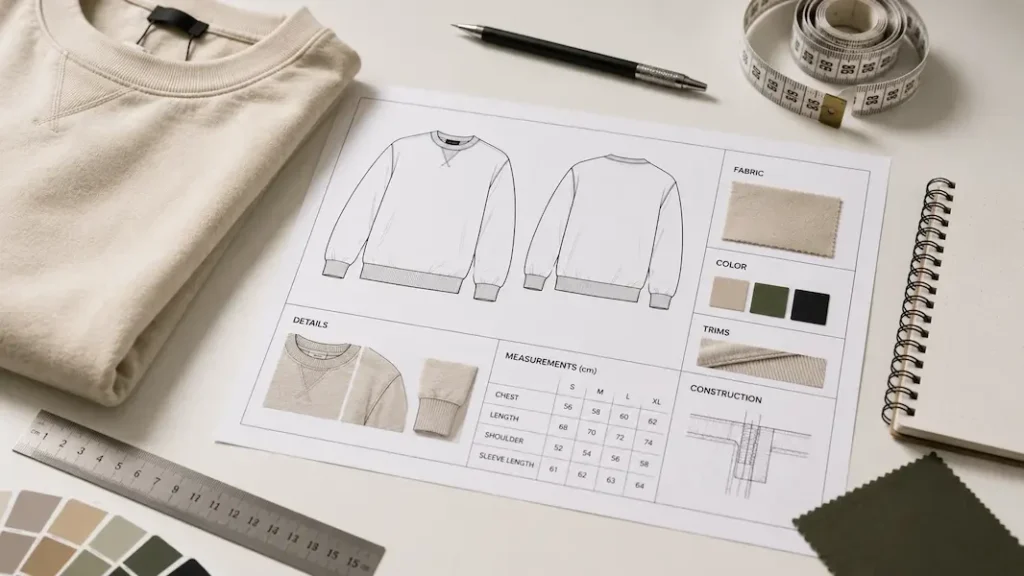
If you are launching a new clothing line, you have likely heard the term “Tech Pack” thrown around. In the apparel manufacturing world, a Tech Pack (Technical Package) is your ultimate blueprint. It is the bridge between your creative vision and the factory floor.
Without a precise Tech Pack, even the best factories are left guessing, which leads to costly sampling errors, misaligned proportions, and delayed product launches.
Whether you are designing a complex technical hardshell jacket or a premium heavy-weight hoodie, here is an insider’s guide on how to create a Tech Pack that manufacturers will actually understand, along with the core elements every garment specification sheet must include.
1. Start with Detailed Technical Sketches (Flats)
Your tech pack should never rely on artistic fashion illustrations. Factories need “flats”—precise, 2D black-and-white drawings of your garment as if it were laid flat on a table.
- Multiple Angles: Always include the front, back, and side views. For outerwear, an inside view is critical to show internal pocket placements and seam-tape routing.
- Micro-Callouts: Zoom in on specific details. Highlight exactly where the custom-molded zippers should sit, the angle of the darting, or the placement of hidden bungee cords.
2. The Heart of the Blueprint: The Bill of Materials (BOM)
A beautiful sketch is useless without a comprehensive BOM. This is the section of your garment specification sheet that lists every single physical component required to build one unit of your design.
- Fabrics: Specify the material composition, weight (GSM), and technical finishes (e.g., 3-layer PTFE membrane, DWR coating).
- Trims & Hardware: List all zippers (e.g., YKK AquaGuard #5), buttons, drawstrings, eyelets, and velcro.
- Labels & Packaging: Specify where your woven neck labels, care tags, and hangtags should be attached.
3. Measurements and Sizing Specs
“Make it a Size Medium” means completely different things in New York, London, and Tokyo. Your Tech Pack must include exact measurements for your “Base Size.” Provide a chart detailing the core points of measure (POM): chest width, center back length, sleeve length, and shoulder drop. A professional tech pack will also include the “Grading Rules”—the mathematical formula for how those measurements scale up to an XL or down to an XS.
4. Construction and Engineering Details
This is where many downloaded tech pack templates fall short, especially for technical activewear. You must tell the factory how to put the pieces together.
- What type of stitching is required? (e.g., Flatlock for chafing-free activewear, or twin-needle for reinforced seams).
- For waterproof outerwear, specify the exact width of the PU seam taping.
- If you have an asymmetric color-blocked design, indicate how the panels should align at the seams.
Don’t Let an Imperfect Tech Pack Stop You
Finding a good tech pack template online is a great starting point, but the reality is that complex garments require industrial engineering. Many emerging brands hesitate to reach out to manufacturers because they feel their tech pack isn’t “perfect.”
At Five Oceans, we view your tech pack as a collaborative starting point, not a final test you have to pass.
As a dedicated custom clothing manufacturer (OEM), we employ in-house pattern masters and technical CAD experts. When you submit your initial sketches or garment specification sheet, we don’t just blindly sew it. We conduct a rigorous feasibility review. If your grading rules are slightly off, or if your seam construction poses a risk of puckering on technical fabrics, our team will engineer the solutions and refine the tech pack with you.
We bridge the gap between your creative concept and our mass-manufacturing reality.
Do you have your sketches or an initial tech pack ready? Contact the Five Oceans technical team today. Let’s review your designs and start engineering your next collection.