Introduction: The Unsung Hero of Waterproof Apparel
In the world of high-performance outdoor and functional apparel, a garment’s waterproof rating often takes center stage. However, even the most advanced waterproof fabrics are rendered useless if their seams are not equally impenetrable. This is where seam sealing comes into play – a critical process that ensures water cannot penetrate through the needle holes created during garment construction. At Five Oceans (伍洋), with over two decades of expertise in garment manufacturing, we understand that effective seam sealing is not just a step, but an art and a science.
This guide will delve into the two primary seam sealing constructions: 3-layer and 2.5-layer, comparing their technical specifications, performance characteristics, and ideal applications. Understanding these differences is crucial for brands aiming to deliver truly waterproof and durable products.
Bottom Line: Choosing the Right Seam Sealing for Your Product
For brands prioritizing maximum durability and protection in extreme conditions, 3-layer seam sealing offers superior performance and longevity. It is the gold standard for professional-grade outdoor gear. Conversely, for garments where lightweight design, packability, and cost-effectiveness are key, 2.5-layer seam sealing provides excellent waterproof capabilities with a more comfortable feel against the skin. Your choice should align with the garment’s intended use and target market’s expectations for performance and value.
Understanding Seam Sealing Technologies
Seam sealing involves applying a waterproof tape over the stitched seams of a garment. This tape, typically made of polyurethane (PU) or thermoplastic film, is bonded to the fabric using heat and pressure, effectively creating a barrier against water ingress. The effectiveness and durability of this bond are paramount.
3-Layer Seam Sealing
In a 3-layer fabric construction, the waterproof membrane is laminated between an outer face fabric and an inner lining fabric. When seams are stitched, a 3-layer seam tape is applied directly over the inner lining, bonding to both the lining and the membrane. This creates a robust, integrated waterproof system.
Key Characteristics: Durability: Highly resistant to abrasion and wear from the inside. Protection: Offers maximum waterproof and windproof performance. Structure: Provides a more substantial feel, often preferred for rugged gear. Applications: Ski jackets, mountaineering shells, heavy-duty rainwear.
2.5-Layer Seam Sealing
2.5-layer fabrics feature a waterproof membrane laminated to an outer face fabric, but instead of a full inner lining, a protective print or coating is applied directly to the membrane’s inner surface. For seam sealing, a 2.5-layer tape is applied over this protective layer, bonding to it and the membrane.
Key Characteristics: Lightweight: Significantly lighter and more packable than 3-layer. Breathability: Often designed for enhanced breathability. Comfort: The protective print prevents the membrane from feeling clammy against the skin. Applications: Lightweight rain jackets, running shells, travel wear.
Performance Comparison: 3-Layer vs. 2.5-Layer Seam Sealing
To illustrate the technical differences, here’s a comparison based on industry standards and Five Oceans’ production experience:
| Feature | 3-Layer Seam Sealing | 2.5-Layer Seam Sealing |
|---|---|---|
| Fabric Construction | Outer fabric + Membrane + Inner lining | Outer fabric + Membrane + Protective print/coating |
| Seam Tape | 3-layer tape, bonds to inner lining & membrane | 2.5-layer tape, bonds to protective print & membrane |
| Durability (Internal) | Excellent (Inner lining protects membrane) | Good (Protective print is less abrasion-resistant than full lining) |
| Waterproof Rating (ISO 811) | Typically 20,000mm H2O+ | Typically 10,000mm – 15,000mm H2O |
| Breathability (MVTR) | Good to Excellent (Often 15,000 – 25,000 g/m²/24h) | Excellent (Often 20,000 – 30,000 g/m²/24h) |
| Weight & Packability | Moderate to Heavy | Lightweight & Highly Packable |
| Hand Feel | More structured, robust | Softer, more flexible |
| Cost | Higher | Moderate |
| Ideal Use | Mountaineering, Skiing, Heavy Rain | Hiking, Running, Cycling, Travel |
The Seam Sealing Process at Five Oceans
Ensuring a perfect seam seal requires precision, the right equipment, and skilled operators. Here’s a simplified flowchart of our seam sealing process:
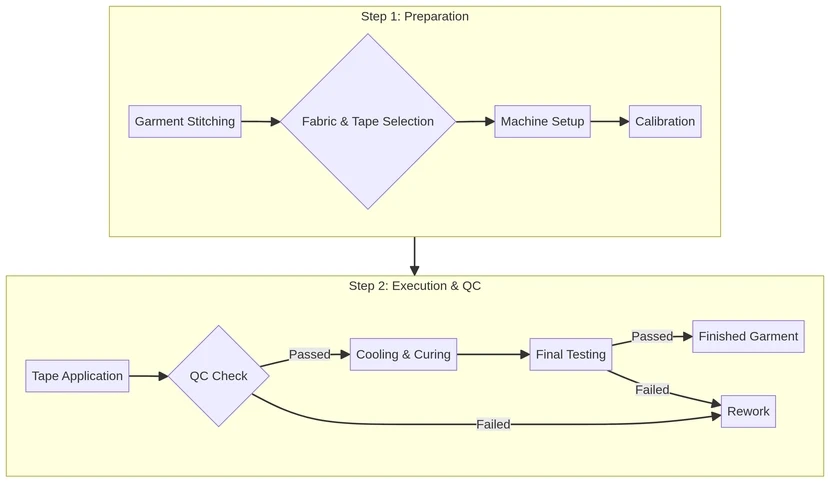
Key Steps and Quality Control at Five Oceans:
1. Fabric & Tape Compatibility: We rigorously test the adhesion between various fabrics and seam tapes to ensure optimal bonding. This includes testing different PU and TPU tapes with specific fabric compositions.
2. Machine Calibration: Temperature, pressure, and speed of the seam taping machines are precisely calibrated for each fabric type and tape, often within a +/- 2°C tolerance.
3. Peel Strength Testing: Post-sealing, random samples undergo peel strength tests (e.g., > 10 N/cm) to verify the integrity of the bond, adhering to internal Five Oceans standards and client specifications.
4. Water Penetration Test: Finished garments or sealed panels are subjected to water column tests (ISO 811) to confirm zero leakage through the sealed seams.
Conclusion: Your Partner in Waterproof Excellence
Whether your brand requires the rugged protection of 3-layer seam sealing for extreme environments or the lightweight versatility of 2.5-layer for active pursuits, Five Oceans possesses the technical expertise and manufacturing capabilities to meet your precise needs. Our commitment to meticulous process control and rigorous quality testing ensures that every garment leaving our factory delivers on its waterproof promise. Partner with us to elevate your functional apparel line with unparalleled seam sealing quality.