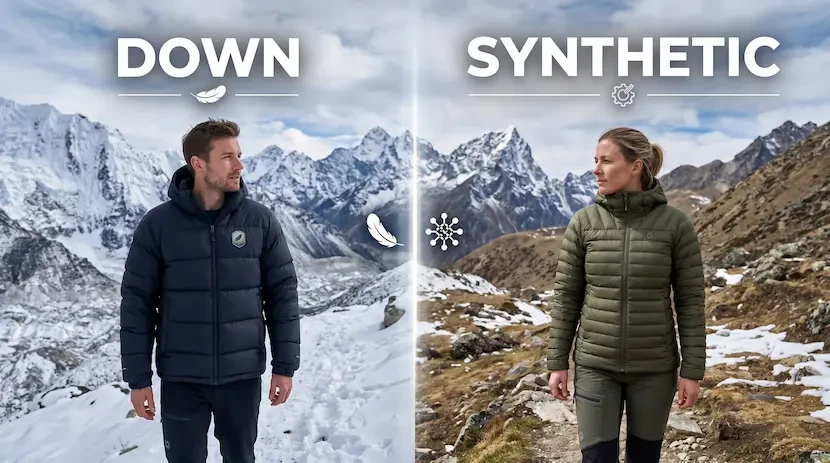
In the competitive landscape of technical outerwear, the insulation choice for puffer jackets is a defining factor for brand identity and product performance. Whether targeting high-altitude mountaineers or urban commuters, understanding the technical nuances between natural down and synthetic alternatives is essential for optimizing your collection’s value proposition.
Natural Down: Unmatched Thermal Efficiency
Natural down is a high-performance biomass consisting of the soft undercoating of geese or ducks. Its primary technical advantage is its ability to trap vast amounts of air within its complex filament structure. This creates a thermal barrier with the highest warmth-to-weight ratio available in the industry today.
- Fill Power (FP): A critical metric representing the volume (in cubic inches) that one ounce of down occupies. Higher FP (e.g., 800+) indicates superior loft and insulating efficiency.
- Compressibility: Down can be compressed significantly for packing and will regain its original loft repeatedly without structural degradation.
Synthetic Insulation: Engineered Resilience
Synthetic insulation is typically composed of polyester filaments designed to mimic the structure of down. While it has historically been heavier, modern engineering has closed the gap significantly. Its most vital characteristic is its hydrophobic nature, allowing it to maintain loft and warmth even when the garment’s outer shell is compromised by moisture.
- Moisture Management: Unlike down, which clumps and loses its thermal properties when wet, synthetic fibers retain their structure and continue to trap air.
- Hypoallergenic & Cost-Effective: Synthetic options are inherently hypoallergenic and generally offer a more accessible price point for mass-market apparel lines.
Technical Comparison Table
| Performance Metric | Natural Down (RDS Certified) | Advanced Synthetic Fiber |
|---|---|---|
| Warmth-to-Weight | Superior (Industry Leading) | High (Improving with Tech) |
| Wet-Weather Performance | Low (Clumps when damp) | Excellent (Retains loft) |
| Compressibility | Excellent (Maximum Packability) | Good (Slightly bulkier) |
| Durability (Lifespan) | Long-term (Decades with care) | Moderate (Fibers may compress over time) |
| Standard Cost | Premium | Competitive / Value-driven |
Strategic Sourcing with Five Oceans
At Five Oceans, we don’t just manufacture; we engineer. We help brands navigate the complexities of insulation sourcing, from ensuring Responsible Down Standard (RDS) compliance to selecting the latest recycled synthetic fibers that align with global sustainability trends. Our production lines in Zhongshan are equipped to handle high-loft materials with precision, preventing down leakage and ensuring uniform distribution across all baffles.
Technical References
- Textile World (2020). The Science of Insulation: Down vs. Synthetic. Available at: textileworld.com
- Responsible Down Standard. RDS Certification and Ethical Sourcing Guidelines. Available at: responsibleduckstandard.org
- Outdoor Industry Association. Technical Standards for Insulation Performance.